

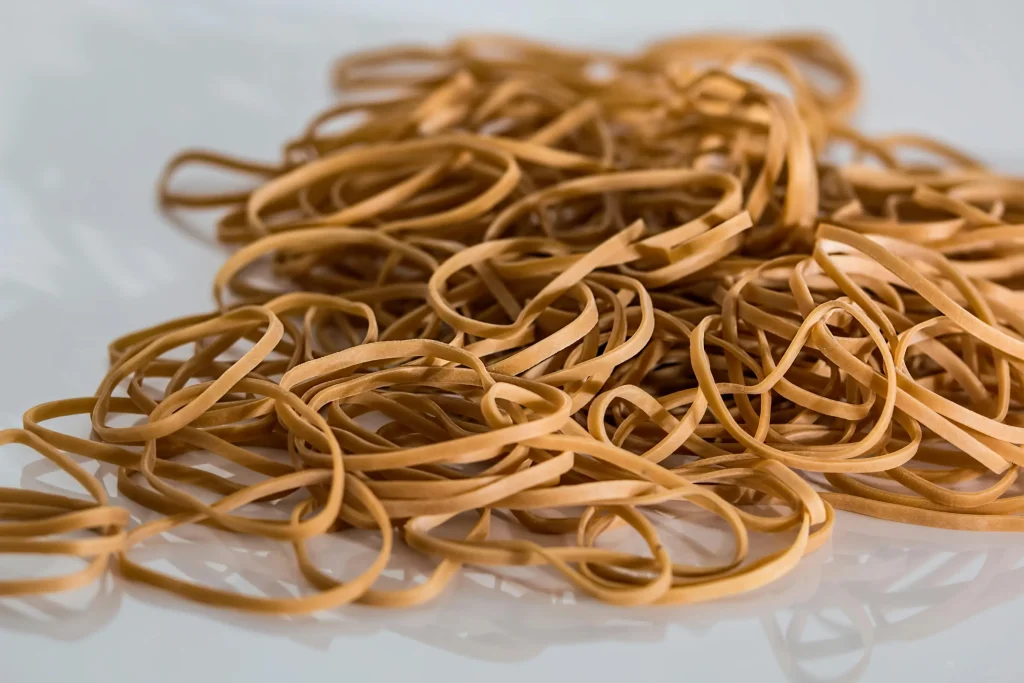
Have you ever wondered if the small, stretchy item in your drawer is safe? Are the rubber bands on your recipe box harmful to your health when you touch them every day in the office or kitchen? Many people started asking this question after the shocking reports about toxic toys for children. The main concern is the suspicion of the presence of toxins that can penetrate the body through the skin. In this article, you will learn what exactly these accessories are made of, whether rubber bands on recipe boxes are actually carcinogenic, and which safe and eco-friendly alternatives you can choose for your home. You will also learn reliable data that will help you take care of the safety of everyday items. We invite you to read on!
What is the rubber compound made of? Composition and production process
The traditional rubber we know from, for example, gardening tools has its origins in nature. The main ingredient is natural rubber, extracted from the rubber tree. It is this raw material that is responsible for the incredible flexibility of the rubber bands. The production process involves vulcanizing the rubber with the addition of sulfur, which makes the material durable and does not stick to the hands.
Remember that not every rubber is the same. On the market, you can find products with different levels of pure rubber – the best ones have up to 90-100%. Cheaper versions are often synthetic rubber, which is made from petroleum. Colorants are also added to the mixture to give it characteristic colors.
Feature, Natural rubber, Synthetic rubber, Origin, Sap of the rubber tree, Petroleum products, Biodegradability, High (natural product), Very low, Allergic reactions to latex, Possible in people with allergies, Rare, Odor, Delicate, rubbery, Often sharp, chemical
Are the rubber bands of the prescription drug are carcinogenic? Hazard analysis
The main concerns about whether the rubber in teething rings is carcinogenic stemmed from reports regarding loom bands (rubber for bracelets). In 2014, independent research in the UK showed that some cheap knockoffs of these toys contained huge amounts of phthalates. Phthalates in rubber are chemicals added to plastic to make it soft. They are classified as endocrine disruptors and can increase the risk of cancer.
Gum caps of the recipe — check the available variants
Do you need strong elastic bands for the office, warehouse, or home? Check the available sizes and choose rubber bands with a high content of rubber, which are durable and resistant to cracking.
However, a standard office formula is a completely different product. If it is made from natural rubber, it does not contain phthalates. The risk arises with products of unknown origin that do not have markings such as a CE certificate or do not meet the EN 71 standard. The toxicity of materials in cheap substitutes from China can be a real problem, so always check the ingredients on the packaging.
Are the rubber bands in the recipe harmful to the environment?
Although natural rubber itself undergoes a process called biodegradation, this does not happen immediately. The decomposition of a rubber chewing gum, even one with a high rubber content, in the natural environment can take many months, or even years. During this time, the discarded rubber poses a deadly threat to birds and small mammals, which mistake it for food (e.g., caterpillars).
Another problem is microplastics. Rubber bands made from synthetic polymers do not decompose, but instead break down into increasingly smaller particles that end up in the soil and water. Therefore, the impact on the environment of prescription rubber bands depends primarily on how they are managed after use. The disposal of rubber bands should take place by throwing them into mixed waste, but it is much better to reuse them repeatedly.
What about an eco-friendly and safe alternative to the recipe's rubber band?
If you want to completely eliminate risk and take care of the planet, there are many zero waste alternatives. They are often more durable and safer when in contact with food. The question of what to substitute the plastic wrap with has many simple answers that you probably already have at home.
Substitute, Use, Benefits, Hemp or jute cord, Packaging, garden, Fully compostable, natural, Metal clips, Office, kitchen, Reusable, no chemicals, Material ties (cloth wipes), Home, hair, Machine washable, no latex, Wood skewers, Kitchen, Natural, cheap
When choosing hemp rope, you can be sure that no chemical substances will penetrate your food. However, if you must use rubber bands, look for those labeled „food grade” – they are approved for contact with food and safer for health. In the office, however, metal clips are a much more durable option – the rubber bands lose their elasticity over time and break, which makes it necessary to replace them frequently.
The ingredients of the recipe – the most important facts
In summary – traditional rubber bands made from natural rubber are safe for most of us, unless we suffer from allergic reactions to latex. The main health hazard, namely the toxicity of the materials and phthalates, mainly concerns cheap knock-off toys such as loom bands. From an ecological perspective, the rubber bands are not ideal, but their biodegradability is significantly better than that of plastic. Remember to reuse them frequently and choose reliable suppliers.
Take care of your environment today. Choose consciously, check the certificates, and don’t be afraid to reach for natural alternatives, such as string or metal clips. Your health and the planet will definitely benefit from it.
FAQ – Most common questions about elastic bands and office accessories
Q: Are the rubber bands in the recipe harmful?
A: Standard natural rubber bands do not show carcinogenic activity. The risk mainly concerns cheap synthetic loom bands, which may contain excess phthalates. To ensure safety, choose products with a CE certificate and avoid those with a strong chemical smell.
Q: Is the smell of prescription gum dangerous?
A: The characteristic smell of a new rubber comes from the sulfur vulcanization process. At low concentrations it is not dangerous to health. However, if the smell is particularly pungent, „petrol-like”, it may indicate the presence of harmful solvents. In such a case, it is better to ventilate the product or refrain from using it in enclosed spaces.



 English
 Polish
 German
 Ukrainian
 French
 Spanish
 Italian
 Romanian
 Bulgarian